Animals with Two Legs & BEYOND (AWTL&B)
Change begins not with instruction, but with attention—and with learning to see who we are in relation to others.
Farmed animals endure more human-made suffering than any other beings, yet they remain largely unseen.
Animals with Two Legs & BEYOND (AWTL&B) is a carefully crafted workshop that brings the unseen into view. Guided by the arc of Knowing–Feeling–Being–Acting (知-感-在-行), it invites participants into the practice of “seeing animals, seeing oneself.” Through games, role-playing, critical debate, and collective reflection, the workshop unsettles habit, loosens distance, and opens space to imagine different ways of relating.

KNOWING
Strange animal laws, everyday customs, cultured meat, climate tax, superbugs, animal hoarding, chicken harvesters. cow brushes……Through team quizzes and board games, pieces are scattered, matched, and misplaced. Knowledge appears in gaps. A shared ground slowly forms.
One participant recalls: “Matching animals with the tools used on them stayed with me. I realised how little I knew—and that discovery pushed me to look deeper, even into research and fieldwork afterwards.”

FEELING
Participants don animal headgear and become egg-laying hens. A voice guides them. Sounds shift. Space tightens. Moving through free-range, barn-raised, and finally caged systems, their bodies register what words usually describe.
One participant recalls:
“At first, I wandered. Then the space closed in. We pressed against each other, and anxiety crept in—I felt the urge to peck at feathers that weren’t mine.”

BEING
Participants are paired with those who see the world differently. The pairing is intentional—A moment of disconfort becomes part of the work. In teams, they perform a ranking exercise adapted from the Moral Expansiveness Scale, deciding who deserves more ethical care—from farmed animals like pigs, fish, chickens, and cows to imagined non-humans such as plants, aliens, and AI robots. It is not a formal experiment, but a staged encounter. Values surface, collide, and shift, turning everyday ethics into something spoken aloud, negotiated in real time, and briefly lived.

ACTING
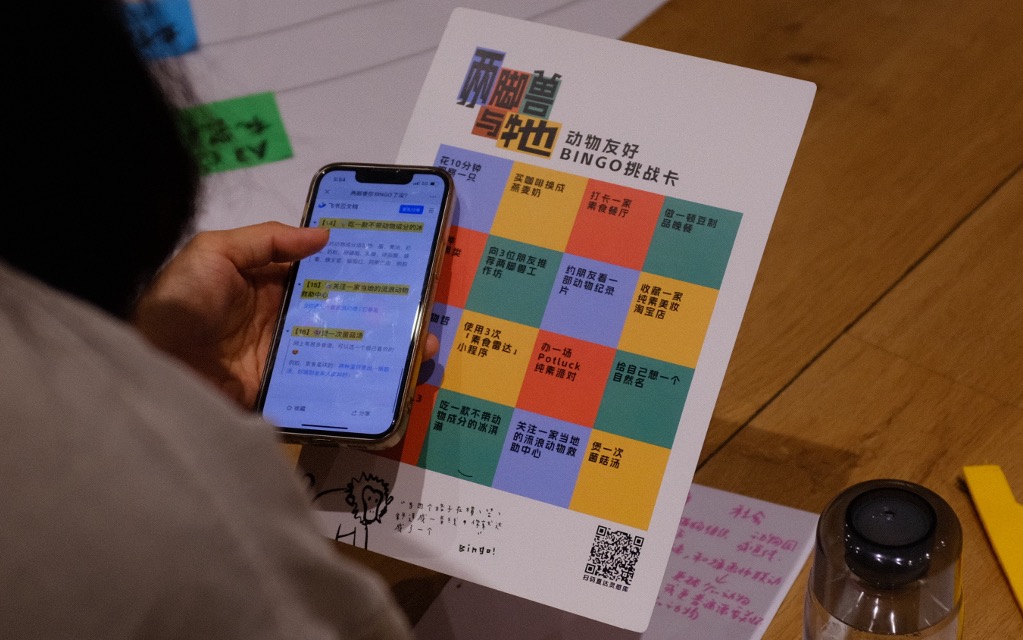
In this session, a simple framework is introduced to help ideas circulate and conversations flow. Participants jot down small, doable actions on the spot, then bring them back to the group for open review. Together, they test the ideas by asking: What feels hardest? What kind of support would make this possible? The focus is not perfection, but momentum—turning reflection into the next, workable step.